Report 2: Mid-Point Technical Proof
This page presents the mid-point technical development of the project, detailing the implemented system architecture, the underlying kinematic model, the complete ROS 2 computational pipeline, and an analysis of real-world system behavior, including sensor uncertainty and run-time performance.
Table of Contents
- Report 2: Mid-Point Technical Proof
- 2. System Architecture
1. Differential Drive Kinematics Model
The differential drive is one of the most common mobile robot configurations. It consists of two independently actuated wheels mounted on the same axis, with a passive caster wheel for balance. By varying the speeds of the left and right wheels, the robot can move forward, backward, and turn. The kinematics model below formally describes how the robot’s motion is determined by its wheel velocities.
1.1 State Vector
The robot’s configuration in the environment is captured by a state vector that describes its position and orientation in the 2D world frame. The state vector is defined as:
\[q = \begin{bmatrix} x \\\ y \\\ \theta \end{bmatrix}\]Where:
- \(x\) and \(y\) represent the robot’s position in the world frame.
- \(\theta\) represents the robot’s heading angle (orientation) measured counterclockwise from the world x-axis.
1.2 Control Inputs
The robot is controlled by independently commanding the angular velocities of its two drive wheels. These are the sole inputs that determine the robot’s motion, making the differential drive an underactuated system — it can only directly control two degrees of freedom (linear and angular velocity) despite operating in a 3-DOF space \((x, y, \theta)\).
The control inputs are the angular velocities of the right and left wheels: \(\dot{\phi}_R\) and \(\dot{\phi}_L\), where wheel radius is \(r\) and track width (wheelbase) is \(L\).
1.3 Forward Kinematics — Mapping from Wheel Velocities to Body/World Velocity
Forward kinematics describes how low-level wheel commands translate into the robot’s motion. Each wheel’s angular velocity is first converted into a tangential linear speed at the wheel’s contact point with the ground:
\[v_{right} = r\dot{\phi}_R \quad \quad v_{left} = r\dot{\phi}_L\]Where \(r\) is the wheel radius. Since both wheels are rigidly coupled to the same chassis, their individual speeds can be combined to determine the robot’s overall linear velocity \(^xv\) (the average of both wheel speeds) and angular velocity \(\omega\) (proportional to their difference). When both wheels spin at equal speeds the robot moves in a straight line; when they differ, the robot turns:
\[^xv = \frac{r}{2} (\dot{\phi}_R + \dot{\phi}_L) \quad \quad \omega = \dot{\theta} = \frac{r}{L} (\dot{\phi}_R - \dot{\phi}_L)\]Where \(L\) is the track width (distance between the two wheels).
1.4 Full World-Frame State Update (the kinematic model)
The robot’s body-frame velocities onto the world frame using the heading angle \(\theta\). This yields the complete kinematic model, a direct mapping from wheel control inputs \((\dot{\phi}_R, \dot{\phi}_L)\) to the time derivatives of the robot’s state \((x, y, \theta)\):
\[\dot{q} = v_{world} = \begin{bmatrix} ^xv cos(\theta) \\\ ^xvsin(\theta) \\\ \dot{\theta} \end{bmatrix} = \begin{bmatrix} \frac{r}{2} (\dot{\phi}_R + \dot{\phi}_L) cos(\theta) \\\ \frac{r}{2} (\dot{\phi}_R + \dot{\phi}_L) sin(\theta) \\\ \frac{r}{L} (\dot{\phi}_R - \dot{\phi}_L) \end{bmatrix}\]This model assumes planar motion on a flat surface, pure rolling contact (no wheel slip), and a rigid chassis, which are all consistent with the standard differential drive assumptions. These equations serve as the foundation for odometry estimation and motion planning in the system’s implementation.
2. System Architecture
2.1 Detailed Computational Map
Mermaid Diagram
  graph TB
    subgraph Perception
        A[RPLIDAR A1M8]
        B[OAK-D Camera]
        CP[camera_processor.py]
        LP[lidar_processor.py]
        OD[object_detector.py]
        CS[clip_scorer.py]
        CM[color_mapper.py]
    end

    subgraph Estimation
        D[SLAM / Occupancy Grid]
        E[semantic_map_builder.py]
        K[kinematics_node.py]
    end

    subgraph Planning
        F[scan_point_generator.py]
        G[vln_integration.py]
        H[exploration_coordinator.py]
    end

    subgraph Control
        I[goal_publisher.py]
        J[Nav2 Stack]
        TB[TurtleBot Hardware]
    end

    subgraph Host_Inference_Server
        S["server.py (YOLO + CLIP + LLaVA)"]
    end

    A --> LP
    B --> CP
    CP --> OD
    CP --> CS

    LP --> D
    D --> F
    D --> E

    OD --> E
    OD --> H
    OD --> G

    CS --> G

    E --> H
    F --> H
    K --> H

    H --> I
    I --> J
    J --> TB

    TB --> K
    TB --> B
    TB --> A

    OD -. REST API .-> S
    CS -. REST API .-> S
    H -. REST API .-> S
RQT graph
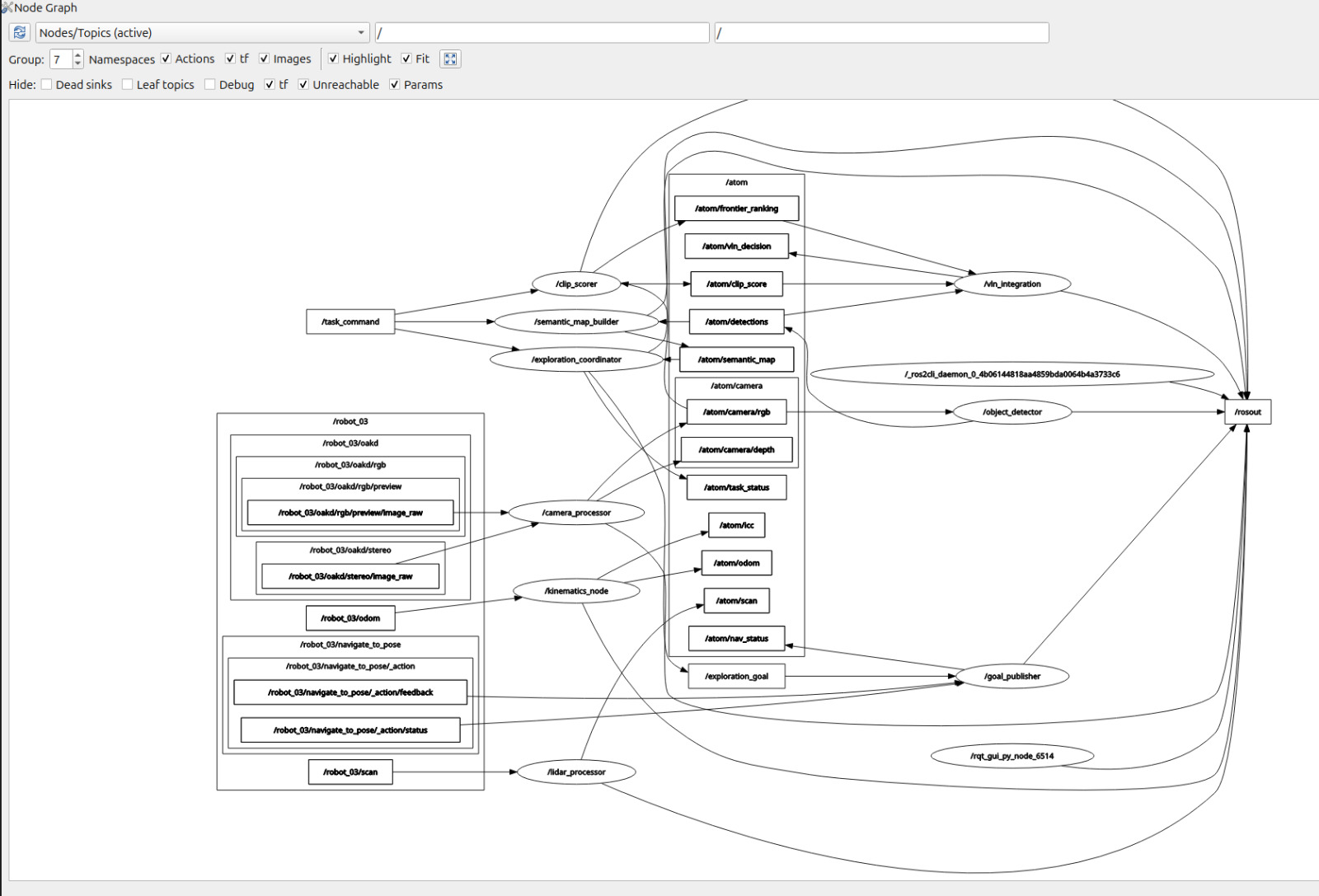
2.2 System Architecture Overview
- The system is implemented as a distributed ROS 2 architecture, where sensing, perception, decision-making, and control are separated into modular nodes that communicate through typed topics and action interfaces.
- Due to computational limitations inside the virtual machine, all heavy deep learning inference workloads are offloaded to a host machine, where a dedicated
server.pyprocess runs YOLO, CLIP, and LLaVA models. - The ROS 2 nodes inside the VM communicate with this server using HTTP REST APIs, where images are encoded as Base64 and sent as JSON payloads, and inference results are returned as structured JSON responses.
-
This architecture ensures that:
- real-time control and navigation remain stable within the VM,
- GPU-intensive workloads are executed efficiently on the host machine,
- and the system maintains modular separation between robotics infrastructure and AI inference.
2.3 Module Descriptions
Library Modules
SLAM / Occupancy Grid (Estimation – Library)
- The SLAM system generates a 2D occupancy grid map $(M(x,y) \in {-1, 0, 100})$, where unknown, free, and occupied cells are represented numerically and updated continuously using LiDAR data.
- The occupancy grid serves as the primary spatial representation of the environment and is used by both the Nav2 planner for path planning and the scan point generator for selecting exploration waypoints.
- The map is published with TRANSIENT_LOCAL durability, allowing late subscribers such as the exploration coordinator to access previously generated map data without requiring re-initialization.
Nav2 Stack (Planning & Control – Library)
- The Nav2 stack is responsible for computing and executing collision-free navigation paths using the occupancy grid produced by SLAM.
- The global planner generates paths using graph-based search (typically A*), while the local planner executes velocity commands that respect dynamic constraints and obstacle avoidance.
- Navigation goals are provided as
NavigateToPoseactions, and feedback is continuously monitored to determine whether the robot has reached, failed, or rejected a goal.
Custom Modules
Camera Processor (camera_processor.py)
- The camera processor node acts as a data bridge between the OAK-D camera driver and the perception pipeline, subscribing to
/oakd/rgb/preview/image_rawand republishing it as/atom/camera/rgb. - The node preserves message headers and timestamps to maintain synchronization with other sensor streams, ensuring consistency across perception modules.
- In addition to RGB data, the node also republishes stereo depth frames from
/oakd/stereo/image_rawto/atom/camera/depth, although this depth information is currently not consumed by downstream modules and is reserved for future integration. - The node uses a BEST_EFFORT QoS policy to match the camera driver’s publishing behavior, preventing message drops due to QoS incompatibility.
LiDAR Processor (lidar_processor.py)
- The LiDAR processor node subscribes to raw
/scandata and filters invalid range values by enforcing a bounded interval ([r_{min}, r_{max}]), where values outside this range are replaced with infinity. - Formally, the filtering operation is defined as: \([ r' = \begin{cases} r & r_{min} \le r \le r_{max} \ \infty & \text{otherwise} \end{cases} ]\)
- This ensures that downstream modules such as SLAM and costmap generation are not affected by spurious measurements or sensor noise.
- The filtered scan is republished on
/atom/scanwith RELIABLE QoS to guarantee delivery to critical estimation components.
Kinematics Node (kinematics_node.py)
- The kinematics node implements the differential-drive motion model using the instantaneous center of curvature (ICC) formulation, transforming velocity inputs into pose updates in the global frame.
- Given linear velocity (v) and angular velocity (\omega), wheel velocities are computed as: \([ v_r = v + \frac{\omega L}{2}, \quad v_l = v - \frac{\omega L}{2} ]\)
-
The pose is updated using either:
- circular motion via ICC when |ω| > 0, or
- linear motion when ω ≈ 0.
- The node publishes refined odometry on
/atom/odomand additionally publishes the ICC position on/atom/iccfor debugging and validation of curved motion trajectories.
Scan Point Generator (scan_point_generator.py)
- The scan point generator extracts strategic exploration waypoints from the occupancy grid by identifying large connected regions of free space.
-
The algorithm:
- converts the occupancy grid into a binary free-space mask,
- applies morphological erosion to avoid boundary regions,
- performs connected component analysis,
- and computes centroids of the largest components as candidate scan points.
- These points are then transformed into map-frame coordinates using the grid resolution and origin and are prioritized based on region size.
- This approach ensures that exploration is guided by spatial coverage rather than random motion.
Color Mapper (color_mapper.py)
- The color mapper provides a lightweight perception filter that maps task descriptions to HSV color ranges, enabling pre-filtering of candidate regions in the image.
- For a given image, a binary mask is computed: \([ \text{mask}(x,y) = \mathbb{1}[H,S,V \in \text{range}] ]\)
- The proportion of matching pixels is evaluated, and if it exceeds a threshold (typically 1%), the color is considered present.
- The centroid of the detected region is computed using image moments, and its horizontal position is used to classify the direction of the object as left, center, or right.
- This module acts as a fast heuristic attention mechanism, reducing reliance on more computationally expensive detection pipelines.
Object Detector (object_detector.py)
- The object detector performs continuous YOLO-based object detection by sending camera frames to the host server’s
/detectendpoint and receiving bounding boxes, class labels, and confidence scores. - Detection outputs are filtered using a configurable confidence threshold before being published as structured JSON messages on
/atom/detections. -
The node also operates in an event-triggered mode, where it responds to
/atom/scan_triggermessages from the exploration coordinator:- in scan mode, it executes color-based filtering,
- [YET TO BE IMPLEMENTED] in verification mode, it sends the current frame to the
/llava_reasonendpoint for semantic validation.
-
Bounding box size is used to estimate object depth using: \(d = 3.0 \cdot \left(1 - \frac{A_{\text{bbox}}}{A_{\text{frame}}}\right)\)
which provides an approximate distance estimate for downstream use.
- The node also publishes visualization frames with annotated detections for debugging and monitoring.
Semantic Map Builder (semantic_map_builder.py)
- The semantic map builder aggregates object detections and projects them into the global map frame using TF2 transformations.
- For each detection, pixel coordinates and estimated depth are converted into camera-frame coordinates and then transformed into the map frame: \([ P_{map} = T_{map \leftarrow camera}(P_{camera}) ]\)
- Objects are stored in a structured list containing class, position, confidence, and observation count.
- Spatial deduplication is performed by merging detections of the same class within a fixed radius (e.g., 0.5 m).
- The resulting map is published as a JSON string on
/atom/semantic_map, providing a transient semantic representation of the environment. - In the current system, this map is not used as the primary driver of navigation decisions, but serves as a perception record.
Exploration Coordinator (exploration_coordinator.py)
-
The exploration coordinator implements a state machine governing the robot’s behavior: \(\text{IDLE} \rightarrow \text{MOVING-TO-SCAN} \rightarrow \text{SCANNING} \rightarrow \text{APPROACHING} \rightarrow \text{VERIFYING} \rightarrow \text{DONE}\)
- Exploration is driven by scan points generated from the occupancy grid, ensuring systematic coverage of the environment.
- At each scan point, the robot performs a structured 360° rotation, pausing at fixed angular intervals to trigger perception.
- When a valid color detection is observed, the robot performs incremental approach steps toward the detected direction, with a maximum number of attempts to avoid false positives.
- Upon reaching a candidate object location, the node triggers LLaVA-based verification before declaring task completion.
- The system is event-driven, where perception signals can interrupt scanning and trigger state transitions.
Goal Publisher (goal_publisher.py)
- The goal publisher converts exploration goals into Nav2-compatible
NavigateToPoseaction requests. - Goals are received as JSON messages and translated into map-frame coordinates with appropriate timestamps and orientation.
- The node monitors action responses and publishes navigation status updates, enabling the exploration coordinator to react to goal completion, rejection, or failure.
CLIP Scorer (clip_scorer.py)
- The CLIP scorer computes similarity between the current camera frame and the task description by querying the
/clip_scoreendpoint on the host server. -
The similarity score is computed as: \(s = \frac{f_{\text{image}} \cdot f_{\text{text}}}{|f_{\text{image}}| \, |f_{\text{text}}|}\)
- Scores above a threshold are published as exploration hints, although these signals are currently not integrated into the navigation control loop.
VLN Integration (vln_integration.py)
- The VLN integration module aggregates perception outputs such as CLIP scores and detection results and publishes structured exploration decisions.
- In the current implementation, these outputs are not directly used to control navigation, but the module provides a framework for future integration of vision-language navigation models.
3. Experimental Analysis & Validation
3.1 Noise & Uncertainty Analysis
Hardware Sensor Characterization
Operating on the real TurtleBot 4 Lite exposed several noise sources that required explicit handling. The RPLidar initially caused “Message Filter dropping message” warnings during startup due to TF2 timestamp mismatches between the rplidar_link and map frames. This is a known timing artifact when localization initializes before the TF tree is fully populated, and it resolves automatically within 5–10 seconds of AMCL convergence. The lidar_processor.py node addresses range validity by discarding readings outside [0.1, 12.0] meters, which eliminates spurious near-field and far-field outliers from the scan.
Odometry noise was characterized by examining AMCL covariance values at startup. Immediately after setting a manual 2D pose estimate in RViz, the AMCL covariance on the x-axis was approximately 0.037 and on the y-axis approximately 0.076 — consistent with a coarse initial pose estimate. After the robot moved 0.3–0.5 meters and AMCL processed several LiDAR scans, covariance dropped below 0.01, indicating good localization convergence. The goal_publisher.py uses this covariance signal to detect when a new 2D pose has been manually set (covariance > 0.1 threshold), storing the pose as the home location.
Camera depth estimation is currently approximated using bounding box size: a larger bounding box implies a closer object, yielding an estimated depth via $d = 3.0 \times (1 - A_{bbox}/A_{frame})$. This is a known limitation, real stereo depth from /oakd/stereo/image_raw is planned for the next iteration.
Simulation Noise Injector
As we are working on real hardware based solution for this project, noise injection for simulation was not written.
3.2 Run-Time Issues & Recovery Logic
The following run-time issues were encountered and resolved during Milestone 2 development.
The most disruptive issue was bt_navigator failing to activate because the default Nav2 behavior tree XML referenced a backup action server that had been disabled in nav2_no_reverse.yaml. The fix was adding default_nav_to_pose_bt_xml and default_nav_through_poses_bt_xml parameters pointing to navigate_w_replanning_only_if_path_becomes_invalid.xml, which contains no backup action dependency. This resolved the “Failed to bring up all requested nodes” error that had prevented any navigation.
TF2 extrapolation errors (“Lookup would require extrapolation into the past”) appeared when Nav2 goals were sent before AMCL had produced sufficient transform history. The solution is procedural: always wait for the initial pose to be confirmed (AMCL logs “Setting pose”) before launching Nav2, and always set the 2D pose estimate before sending task commands. Additionally, bt_navigator sometimes required manual lifecycle activation via ros2 lifecycle set /bt_navigator configure && activate when the lifecycle manager timed out.
3.3 Milestone Video
SLAM and Navigation Validation
The first video demonstrates the stability and correctness of the SLAM and navigation stack in isolation. In this experiment, an initial pose is manually set using RViz, after which a target goal pose is provided through the navigation interface. The robot successfully plans and executes a collision-free path from the initial pose to the target location using the Nav2 stack, validating the integration between SLAM-based localization and the global planner. The motion is smooth and consistent, indicating that the underlying occupancy grid, costmaps, and control pipeline are functioning as expected. This experiment confirms that the geometric navigation layer of the system is reliable when operating independently of higher-level perception and decision modules.
Object Detection and Reactive Behavior
The second video demonstrates the perception-driven behavior of the system using the object detection pipeline. In this setup, the robot continuously processes camera input and performs object detection using the YOLO-based inference pipeline. When the specified target object is present in the camera view, the system halts robot motion, indicating successful detection and triggering of the stop condition. Conversely, when the object is removed from the scene, the robot resumes motion, demonstrating a reactive control loop driven by perception signals. For the purpose of this demonstration, a fixed navigation goal was temporarily hard-coded, as the scan point generation module has not yet been fully integrated into the exploration loop. This experiment validates that the perception pipeline and control interface operate correctly when tested independently.
3.4 Future Improvements
-
The current system exhibits inconsistent behavior when all modules are integrated, particularly in the interaction between the exploration coordinator and the perception pipeline. Future work will focus on debugging and stabilizing the exploration coordinator, ensuring that state transitions and perception-triggered events are handled deterministically and without unintended delays or race conditions.
-
The scan point generation module, although implemented, is not yet fully integrated into the exploration loop. Future development will focus on replacing the temporary hard-coded navigation goals with dynamically generated scan points derived from the occupancy grid, enabling systematic and autonomous exploration of the environment.
-
The current depth estimation approach relies on bounding box area as a proxy for distance: \([ d \propto \left(1 - \frac{A_{\text{bbox}}}{A_{\text{frame}}}\right) ]\) which introduces significant inaccuracies due to perspective distortion and object size variability. This approximation will be replaced with a more robust depth estimation method, leveraging stereo depth from the OAK-D camera or geometric projection techniques.
-
The system currently exhibits limitations in accurately approaching detected objects, often failing to reach precise target positions. This is attributed to both depth estimation inaccuracies and coordination issues within the exploration pipeline. Future improvements will focus on tighter coupling between perception outputs and navigation goals to achieve more precise object-centric motion.
-
The integration of perception modules into a unified decision-making pipeline remains partial. At present, YOLO is fully integrated and serves as the primary perception backbone for object detection. Future work will focus on incorporating CLIP-based scoring to guide exploration direction by evaluating scene relevance with respect to the task, and integrating LLaVA for robust semantic validation of detected objects. This will enable a more coherent vision-language navigation framework where directional exploration is informed by CLIP, detection is handled by YOLO, and final confirmation is performed using LLaVA, replacing the current reliance on primarily geometric scanning and reactive behavior.
4. Project Management
4.1 Instructor Feedback Integration
| Question | Answer according to the code and report |
|---|---|
| 1. Do you plan to add more objects to the environment? How will you handle objects added or removed by other students in a common space during operation? | The current system does not rely on any persistent semantic memory or object registry for decision-making. Instead, the robot performs full environment exploration irrespective of prior detections or environmental stability. Exploration is driven by scan-point coverage and perception signals rather than stored object information. As a result, the system is inherently robust to dynamic changes in the environment, including objects being added or removed by other users, since it continuously re-perceives the environment during operation rather than relying on previously stored object states. |
| 2. How exactly are you calculating positional error? | Positional error is not explicitly computed in the current implementation. After discussion with the instructor, this was intentionally deferred due to the complexity involved in validating SLAM-based estimates. Accurate error computation would require a secondary ground-truth localization system that is more precise than SLAM itself, which introduces significant additional complexity. As a result, positional accuracy is currently treated as a qualitative performance metric rather than a quantitatively evaluated parameter. |
| 3. What specifically are “suggested actions” under the VLN integration? | Suggested actions correspond to high-level behavioral directives such as continuing exploration, moving toward a candidate region, stopping, or adjusting motion direction. These actions are not yet implemented as direct control commands but are conceptual outputs derived from perception signals such as YOLO detections, CLIP similarity scores, and, in future work, LLaVA-based reasoning. The intention is for these signals to be fused into a decision layer that determines the next robot action based on multiple perception modalities. |
| 4. I’m not quite understanding the need for the YOLO model if the VLN model already takes camera images and instructions as inputs. Could you clarify? | In this project, the VLN system is not used as a pre-trained end-to-end navigation model. Instead, the system is being built as a custom VLN stack by integrating multiple components, including SLAM, object detection, and vision-language reasoning models. YOLO serves as the primary perception backbone by providing explicit object detections, including class labels, bounding boxes, and confidence scores. These detections form the structured representation of the environment, which is necessary for downstream reasoning. The VLN component, rather than replacing YOLO, is intended to operate on top of these structured perception outputs to guide exploration decisions. |
| 5. If the VLN outputs waypoints in the SLAM map, what custom work is required to convert that to a Nav2 goal? I see that as a very short task, is the bulk of the custom work in the semantic map builder? | The core work lies in designing and integrating a custom VLN pipeline that generates the waypoints. This involves combining SLAM-based spatial understanding, object detection outputs, and high-level reasoning from language models to determine meaningful navigation targets. Therefore, the complexity lies in the decision-making pipeline that produces navigation goals, rather than the final conversion step handled by the Nav2 interface. |
4.2 Individual Contribution
| Team Member | Primary Technical Role | Key Commits | Specific File(s) / Components |
|---|---|---|---|
| Akshaya J | Perception & Reactive Exploration | 9f24d24, 7139b9b, 31989a9, 6e28713 | object_detector.py camera_processor.py color_mapper.py server.py (YOLO) exploration_coordinator.py |
| Nivas Piduru | Mapping, Environment Understanding & VLN Integration | 33d7be0, 67cda18, b1273ae, 823fa91, 456ad6d | lidar_processor.py semantic_map_builder.py vln_integration.py server.py (CLIP) exploration_coordinator.py |
| Moss Barnett | Motion, Control & System Integration | 7b25d3c, 5694b81, 2d30dcd, 58d5baa | kinematics_node.py clip_scorer.py goal_publisher.py launch file |